What Is Spring Rate?
Spring rate is a measure of the force magnitude required to deform (e.g., compress or extend) the length of the spring by a standardized distance. It is expressed as a rate in either lb/in or N/mm, depending on the units of measurement. It is also commonly referred to as the spring constant, represented by k in mathematical formulas. It also demonstrates the physical principle known as Hooke's Law, which states that the counteractive force exerted by a spring is directly proportional to its deflection.
The Spring Rate Formula
Using a compression spring as an example, the spring rate can be mathematically expressed in two related forms depending on whether you are looking at the overall force-displacement relationship or the physical specifications of a compression spring:
Basic Relationship - Hooke’s Law:
The equation below shows the relationship that holds for most helical coil springs. The Force (F) vs Displacement (x) relationship is linear, with the gradient (or slope) denoted by a constant value (k), where k is called the spring rate.
F = k × x
Or expressed another way:
k = F / x
Where:
- k = spring rate (also commonly denoted as R)
- F = force applied to the spring
- x = spring deflection under applied force
Put another way, the spring's resisting force (F) is directly proportional to its deflection, or change in length (x), according to the spring rate (k).
Furthermore, in simple spring cycling between two points (denoted as Point 1 and Point 2), the spring rate can also be written as:
K = ΔF / ΔX
Where:
- K = spring rate
- ΔF = Change in force applied to the spring: F₂ − F₁
- ΔX = Change in deflection of the spring: X₂ − X₁
Using Physical Spring Properties:
You can use a simple formula to calculate the spring rate from the physical and material properties of a given spring. Specifically, the spring rate is directly proportional to the material's modulus of rigidity and the fourth power of wire diameter, meaning a thicker wire diameter dramatically increases stiffness. Conversely, it is inversely proportional to the number of active coils and the cube of the mean coil diameter, meaning a spring with more active coils or a larger diameter is significantly less stiff, or less resistant to high load magnitudes.
k = (G × d⁴) / (8 × D³ × Nₐ)
Where:
- k = spring rate
- G = modulus of rigidity (shear modulus) of the spring material
- d = wire diameter
- D = mean coil diameter
- Nₐ = number of active coils
How to Calculate Spring Rate
To calculate a spring's rate directly, divide the magnitude of the applied load by the resulting deflection distance the spring undergoes under that force.
For example, using the fundamental relationship for spring rate (k):
k = F / x
If an applied load (F) of 20 pounds (lb) deflects a spring a distance (x) of 2.0 inches, the resulting spring rate is calculated as follows:
k = F / x = 20 lb / 2 in = 10 lb/in
Note: While this example allows calculation of spring rate during use, engineers can also mathematically predict spring rate in the early design phases using a specification formula that calculates the expected rate from the spring's physical properties, including the material's modulus of rigidity (G), wire diameter (d), mean coil diameter (D), and the number of active coils (Nₐ).
What Affects Spring Rate?
A spring's rate is determined mainly by its physical geometry and material composition as governed by four critical design factors.
- Wire diameter (d) is the most impactful dimension, as the spring rate equation raises it to the fourth power. This means that even a small increase in the spring’s wire thickness leads to a much larger spring rate, making the spring significantly stiffer.
- Mean coil diameter (D) & Number of active coils (Nₐ) are both inversely proportional to stiffness, meaning a larger mean coil diameter or more active coils decreases the spring rate and makes the spring less stiff.
- Material (G): The modulus of rigidity, also known as the material’s shear modulus (G), directly impacts the spring rate, making the selection of appropriate spring materials essential to achieving your desired load performance.
Spring Rate for Compression, Extension, and Torsion Springs
Spring rate is a property of all three primary spring types: compression, extension, and torsion springs. However, its expression differs for each spring because the direction of deformation varies slightly across these three types.
Compression Springs
Compression springs represent the most common context for spring rate. In compression springs, deformation shortens the spring, decreasing the gap between the coils under an applied load. The spring rate is linear from 15% to 85% of maximum rated deflection.
Below 15%, there is not enough deflection/movement in the active coils, while beyond 85%, the dead coils (end coils) may also be moving.
Extension Springs
However, the spring rate for extension springs requires a qualifier note regarding the applied load required to deform the spring. Extension springs are tightly wound coils that stretch apart under load; consider the spring’s initial tension, as it represents the minimum force required to separate the adjacent coils before measurable displacement occurs at the ends of the spring. As such, spring rate is calculated as follows:
k = (F − IT) / x
Where:
- F: Total Applied Spring Force
- IT: Initial Tension (extension springs only)
- X: Measure spring extension
Additionally, in simple spring cycling between two points (denoted as Point 1 and Point 2), the spring rate can also be written as:
Spring Rate = (F₂ − F₁) / (X₂ − X₁)
Where F₂ is the measure of the force at the point of maximum extension, which is measured by X₂.
and:
Where F₁ is the force at the point of minimum extension, measured by X₁.
Torsion Springs
Because torsion springs operate by twisting rather than axial deformation, the spring rate cannot be expressed as a simple force-per-inch relationship. Therefore, the spring rate is expressed as a torque per degree, with typical units of either:
k = in·lb / deg.
or
k = N·mm / deg.
When the applied torque (T) and resulting angular deflection (Θ) of the torsion spring are known, the spring rate is calculated using the basic formula:
k = T / Θ
Where:
- k = Torsion spring rate
- T = Applied torque (lb·in) or (N·mm)
- Θ = Angular deflection in degrees
In mechanical assemblies, torque is generated when a linear force (F) pushes perpendicularly against a protruding leg at a specific distance from the spring’s center axis. Therefore, torque (T) is defined as the force multiplied by the moment arm distance (L):
T = F × L
Substituting the torque (T) relationship directly into the spring rate equation yields the combined formula for torsion spring rate:
k = (F × L) / Θ
For reference, if you have a known torque (T) and want to know the equivalent linear force on the torsion spring legs (denoted by L), you can rewrite the equation as follows:
F = T / L
For example, suppose a mechanism applies 6.0 lb (F) to a torsion spring leg at a point located 1.5 in. (L) from the spring body centerline, causing the leg to rotate through an angle of 30 degrees:
- Calculate Torque (T):
T = F × L = 6.0 lb × 1.5 in = 9.0 lb·in - Calculate Spring Rate (k):
k = (F × L) / Θ = (9.0 lb·in) / (30 degrees) = 0.30 in·lb/deg.
Linear vs. Variable Spring Rate
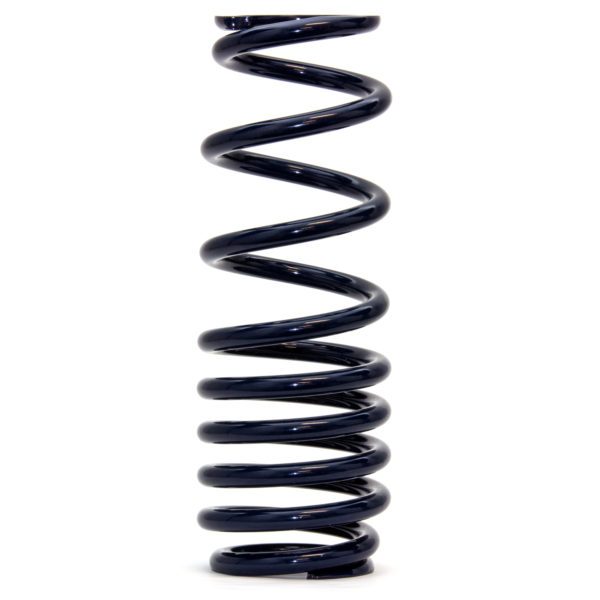
Most standard springs are designed with a linear (i.e., constant) spring rate, so the force-to-deflection ratio remains the same throughout their working range. In contrast, specialty components like variable-pitch, conical, or tapered springs feature a variable or progressive spring rate, where stiffness changes under load.
Progressive springs are engineered to have increasing stiffness through the compression profile, providing greater resistance as the spring deforms. This specialized response is ideal for vibration-isolation and dynamic-loading applications where constant-rate compression springs cannot provide the desired force-deflection performance.
Why Spring Rate Matters When Choosing a Spring
Selecting the correct spring rate is critical to your mechanism's overall performance because a spring that is too stiff will not deflect enough under your design loads. Conversely, one that is too soft will fail to provide sufficient force resistance. Furthermore, exceeding safe deflection limits by using an inadequately rated spring can cause the component to either take a permanent set, bottom out, produce coil bind, or undergo severe plastic deformation. All of which can severely impede spring function and lead to premature failure or outright fracture.
You should always verify that your spring will operate within its ideal linear deflection range—typically between the center 20% to 80% of its maximum rated deflection. This is critical for a predictable load response and long service life.
To help you achieve this balance, Century Spring’s expert engineering team helps you calculate your precise loading requirements and navigate our expansive catalog of over 40,000 in-stock springs.
If a standard component does not fit your exact space envelope or force-deflection profile, we can engineer custom spring solutions to fit your application's unique dimensional and environmental requirements.
Frequently Asked Questions About Spring Rate
What units is spring rate measured in?
For compression and extension springs, spring rate is measured in pounds per inch (lb/in) or Newtons per millimeter (N/mm), depending on the measurement system. For torsion springs, which resist rotation, the rate is measured in torque per unit of angular rotation, typically written as inch-pounds per degree (in·lb/deg.) or (N·mm/deg.)
Does a higher spring rate mean a better spring?
No, a higher spring rate does not mean a spring is better, as the rate simply measures the stiffness or force magnitude required to deflect the spring a single unit of displacement. If the spring rate is too high, the component will be too stiff to achieve the necessary displacement to actuate your mechanism; if it is too low, it will fail to provide the required load capacity. Therefore, the optimal spring is always one that is "right-sized" to balance your system's specific loading requirements and spatial design constraints.
Does spring rate change as the spring compresses?
In most springs, the spring rate is constant through the entire deformation profile of the spring, meaning the stiffness does not change. However, specialized springs, such as progressive or variable-rate springs, are engineered with non-uniform coil spacing or tapered shapes to create a spring rate that varies with deformation.
How do I determine the spring rate I need?
To determine the precise spring rate required for your application, you must first evaluate the target working load (torque for torsion springs) the spring needs to absorb and the allowable deflection (angular displacement for torsion springs) your mechanism's spatial envelope can accommodate. Once these target values are defined, you can calculate the approximate rate by dividing the expected force (or torque) by the physical distance the spring must travel (degrees of rotation).
If you only know the installed spring’s working length, you might select a candidate spring that is 30% longer than this value. Then you can compare its calculated load output at that height to your application's actual load requirements. This screening exercise ensures your spring operates within safe limits without exceeding its maximum rated deflection.
Get Help Choosing the Right Spring
Navigating spring force, deflection, and dimensional requirements can be challenging. Century Spring's subject matter experts are equipped to help you shop stock springs from our expansive inventory or custom-design a spring with a precision spring rate engineered for your mechanism.
Whether you need to find a standard part within our catalog of over 40,000 in-stock designs or require a bespoke solution built completely from scratch, we will partner with you through all phases of development. You can quickly Request a Custom Quotation online to begin your joint development process.
Other Contact Options to reach our dedicated support teams include a direct phone line at 800-237-5225 to speak immediately with a live representative for technical assistance. You can also send an email directly to our dedicated inbox.