Springs for Medical Devices

Century Spring is a leading medical spring manufacturer and trusted supplier to the medical device industry, boasting an ISO 13485:2016 certified quality management system and decades of expertise designing high-quality springs and wire-form products.
We understand that quality and engineering excellence are indispensable prerequisites in all areas of medical device design and procurement and are relied upon to perform critical life-sustaining functions. Medical-grade springs are found in various devices, including surgical equipment, hand tools, syringes, drug delivery devices, and implantable devices. Medical device springs in such applications provide precise motion and force control. They also must be biocompatible, and wire forms must be precision-manufactured to small sizes and tight tolerances.
As an ISO 13485 certified medical spring manufacturer, we also provide custom spring designs that meet rigorous industry standards, from raw material procurement to final surface finishing. Our dedicated custom spring development and customer support teams are well-versed in the technical requirements of medical devices. They are equipped to help you navigate design criteria, such as spring size, materials, surface finishes, and end types, to find the best spring solution for your medical device.
Whether you need a simple compression spring for a pill dispenser or a custom high-strength, corrosion-resistant spring for surgical equipment, discover how our expansive spring inventories and custom spring manufacturing expertise can best serve you today!
Explore Our Springs for Medical Devices
Century Spring supplies high-quality medical device springs and wire form products that meet rigorous design and quality standards. We offer a comprehensive selection of compression, extension, and torsion springs well-suited for medical devices, with same-day shipping options available.
We stock a wide range of small springs in materials suitable for compact medical devices, including 302, 304, and 316 stainless steels—widely used for their excellent corrosion resistance against fluids and chemicals in medical settings.
Browse our catalog of helical coil springs by material and filter by wire size and outer diameter to find the right fit. Download free CAD models of all our stock springs to verify compatibility before purchase.
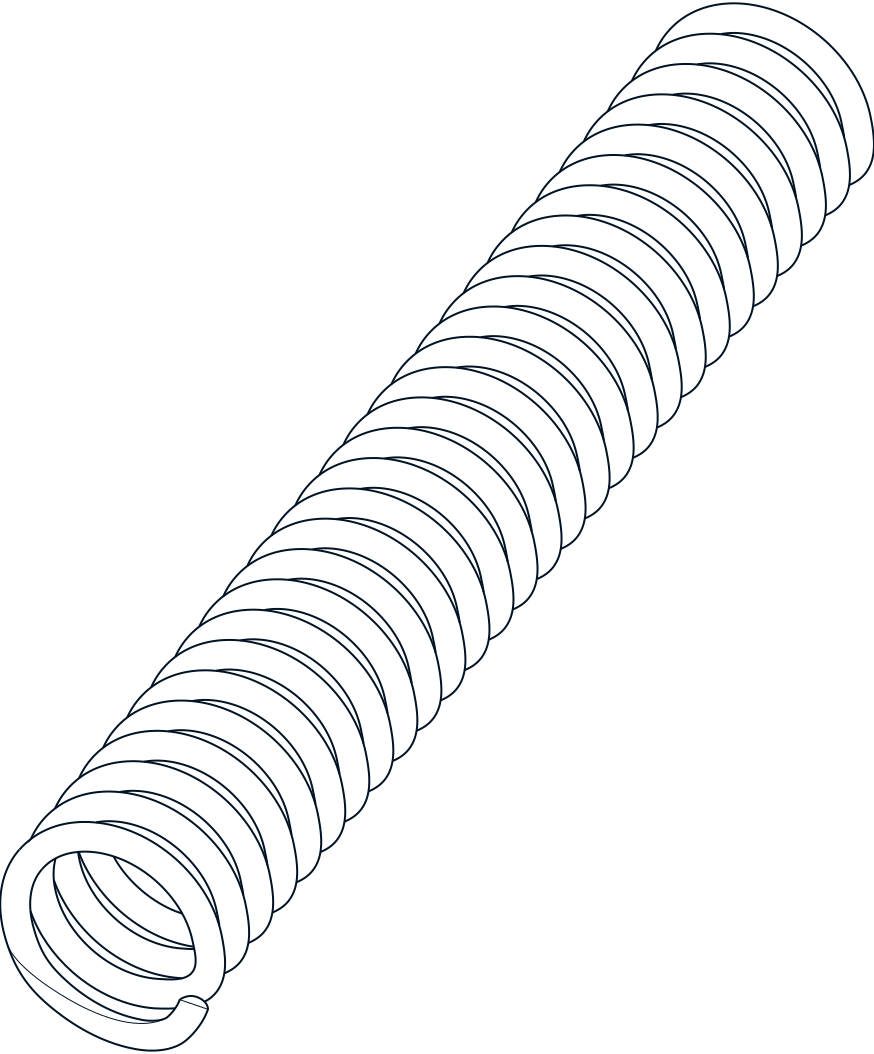


Custom Medical Device Springs
If you can't find what you need in our catalog, Century Spring offers decades of design and manufacturing expertise for custom spring projects. We provide configurable options including high-strength materials and various end types, with thousands of customization options engineered for demanding medical device requirements.
Whether you're in the design or procurement phase, our dedicated custom spring development team will help you navigate critical design criteria—size, material, surface finish, and cleanliness requirements. We partner with you from initial concept to final procurement, providing test samples along with design and quality documentation to support your development and qualification activities.
Custom Spring Manufacturing for Medical Applications
We fabricate all custom springs using in-house state-of-the-art CNC wire-forming machines and automated secondary production processes, reliably producing springs to the tight tolerances medical devices require.
We can produce high-quality springs with wire diameters as small as 0.005", ideal for surgical equipment. Our high-speed machines quickly scale production to the volumes required for consumable medical devices.
We maintain stock of specialized materials including 17-7 Stainless Steel, Inconel, and Elgiloy, and partner with experts to provide secondary finishing operations such as passivation, electropolishing, and ultrasonic cleaning.
Our focus on minimizing lead times means we can deliver customized medical springs within two weeks of receiving your purchase order, with expedited options available when needed.
What Our Customers Are Saying
“Terrific customer service agents who are willing to research and find the answer if they don't know. Nice email updates and quick product delivery.”
“I am surprised that a big company like yours would work with us little guys. And Thank You because we don't have another source for springs.”
“The website works really well, that is very important to me to find what I need quickly and accurately.”
Springs for Medical Devices: Information & Resources
Types of Springs Used in Medical Devices
Our customers in the medical device industry rely on our precision springs to ensure reliability even in the most demanding medical devices and equipment. Compression, extension, and torsion helical coil springs are commonly used in various medical devices and equipment, ranging from surgical tools to implantable medical devices. Some of the most common applications are highlighted below:
- Handheld Surgical Instruments: Any handheld device, such as a wire retractor used to hold tissue in place during surgical operations, likely incorporates a torsion spring to provide the mechanical force necessary for the device to function.
- Drug Delivery Systems, Syringes and Auto-Injectors: An auto-injector is a device that delivers a concentrated, high dosage of a drug, sometimes through a patient’s clothing. The integrated compression spring provides the force needed to inject the medication in such devices. For example, EpiPens are auto-injectors that quickly provide high drug dosages directly to tissue to prevent anaphylaxis. Additionally, insulin pumps are another common wearable auto-injector that continuously monitor blood sugar and deliver insulin when needed, mimicking the natural function of the pancreas.
- Hearing Aids: Micro-tapered compression springs are commonly used within the battery compartments of hearing aids, providing the conductive path necessary for the device to function properly. They may also be found in the device's tiny audio switches and relay circuits.
- Ventilators: Like medical pumps and valves, ventilators are complex life-sustaining medical equipment. Both compression springs and tension springs are commonly used in ventilators to facilitate proper airflow through the device.
How to Select the Right Medical Spring
Helical coil springs, including those used in medical devices, are defined by similar geometric properties regardless of the exact spring type, such as Wire Diameter, Outer Diameter (OD), and Spring Rate.
After determining the working load your spring must withstand, you can shop for medical device springs by spring rate. Use this value to calculate the spring displacement in your application, which will help you determine how the spring will operate under load in your medical device. This then allows you to determine the approximate wire diameter and outer diameter of equivalent springs that suit your application, highlighting the fit and function of your medical device spring.
You may need to measure other critical dimensions that are unique to each type of helical coil spring. For example, extension springs are defined by their Length Inside Hooks. In contrast, important torsion coil spring properties are the Angle between the Legs and the Leg Length. Finally, geometric properties such as the End Eype and Solid Spring Length are important compression spring properties.
The most important consideration when selecting a medical device spring is the Spring Material. As stated previously, 316 stainless steel is the most widely used spring material for surgical equipment applications because it is an economical material option that is strong and durable, chemically inert to air and fluids, and has a smooth surface finish, which makes parts and components very easy to clean and sterilize.
We offer a variety of surgical-grade spring materials, available as custom options and in stock. These include 300 series Stainless Steel, Beryllium Copper, Cobalt Chrome, Phosphorus Bronze, Nitronic, Elgiloy, Titanium, and high-performance plastics such as PEEK, suitable for select spring types.
We created three standalone spring selection guides, each featuring additional detailed design and spring sizing resources for stock compression, extension, and torsion springs, to further guide your medical device spring selection process.
These guides feature all the critical design and sizing information you need to select a spring suited for your medical device application.
How to Select a Torsion SpringHow to Select a Compression SpringHow to Select an Extension Spring
Quality Standards and Certifications
Century Spring is a quality-first, ISO 9001: 2015 and ISO 13485:2016 certified medical spring manufacturer and supplier specializing in stock and custom springs.
What Is ISO 13485:2016?
When you purchase from a company with ISO 13485 medical device certification, you ensure that you’re getting springs that meet the international standard for quality management for medical device manufacturers. Century Spring, as an ISO 13485 certified medical device component manufacturer certified, is proud to provide you with the best for your medical devices.
We can support the complete Production Part Approval Process (PPAP) submission at all levels for all of our springs and wire form products. The PPAP is a standardized procurement classification commonly used in aerospace and defense industries. It enables suppliers to demonstrate their ability to consistently manufacture parts that meet all customer design and quality specifications.
All our products comply with the International Traffic and Arms Regulations (ITAR), Restriction of Hazardous Substances (RoHS) regulations, Defense Federal Acquisition Regulation Supplement (DFARS), Registration, Evaluation, Authorization, and Restriction of Chemicals (REACH), California Proposition. 65, and all applicable Conflict Minerals Regulations.
All compliance documentation can be made available upon request. For additional information on these and other certifications held by Century Spring, see our Certification and Compliance Resources.
FAQs About Springs for Medical Devices
What are the most common types of springs used in medical applications?
Medical device springs are most commonly small helical coil springs that fall within one of the three primary spring subtypes differentiated by the direction of the load and displacement they are designed to accommodate. These subtypes include extension, compression (such as conical, tapered, or barrel springs), and torsion springs.
Do I need a custom spring design for my medical device?
Many standard stock stainless steel springs are available across many geometries and specifications. However, if you determine that you need a custom spring that we do not carry in stock, call us today at 800-237-5225 or fill out our Custom Quotation Form today!
How can I extend the life of my medical device spring?
In general, you can enhance the longevity of your spring by considering these design factors.
- Optimize your Design: To minimize spring stress during deformation, consider using a smaller spring with larger wire diameters or explore ways to reduce the design loads of your application.
- Consider Material and Environmental Protection: Select suitable materials and treatments compatible with specific environmental conditions.
- Cyclic Loading: If your application does have significant dynamically oscillating loads, you should check to ensure that the operating frequency is significantly lower than the spring's natural frequency to avoid resonance issues
What material should I choose for my medical device spring?
In short, consider your application's mechanical loads, corrosion resistance, and temperature requirements. If your application experiences high loads or deformations, consider a high-strength alloy. If corrosion resistance is paramount, consider using a stainless steel spring. Additionally, advanced Nickel-based alloys may be appropriate for use in applications that experience very high temperatures.
What geometric tolerances can I expect on my spring?
Spring tolerances depend heavily on the exact spring type and geometry. As such, we have performed extensive empirical studies, which we have used to develop tolerance equations for different manufacturing techniques. We have combined these with the best industry standards to create general tolerance ranges for springs commonly employed in the Aerospace and Defense industries. However, these calculations can be very involved, so we have integrated them into our design and manufacturing automation software.
However, if you Contact our Design Team today, we will gladly walk you through these calculations to provide general tolerance values for your spring type and geometry!
What is the difference between 300 series stainless steel alloys (e.g., 300/302 and 316)?
The primary difference between stainless steel alloys 300/302 and 316 is their corrosion resistance. Alloy 300/302 is a general-purpose stainless steel with good corrosion resistance in applications with moderate exposure to water or mildly corrosive media. In contrast, 316 stainless steel exhibits greater corrosion resistance against a wide range of fluid medium applications, so it is commonly used in medical and food-grade applications.
What are the primary advantages of passivated stainless steel springs?
The primary advantage of passivated stainless steel springs is the chromium oxide surface layer, the chemical mechanism that provides excellent corrosion resistance to stainless steel. This surface layer prevents additional oxygen from reacting with the iron below. Passivating is a secondary chemical process that increases the thickness of the surface layer to ensure it is sufficiently thick and unbroken. As such, it is strongly recommended for springs subjected to highly corrosive media.
Why Choose Century Spring

Our Commitment to Quality and Service
As the most trusted name in spring manufacturing, Century Spring is a quality-first, ISO 9001 and AS9100D certified spring and wire form product manufacturer and supplier, specializing in both stock and custom springs. We offer rapid delivery on over 40,000+ stock springs, available to ship today, because we understand the importance of meeting your design scheduling constraints.
Our experienced product engineers, knowledgeable product quality team, and skilled manufacturing personnel always deliver the highest quality products to you faster than our domestic and international competitors. Our products are always made in the USA.
Innovation and Customization in Spring Manufacturing
Century Spring combines state-of-the-art manufacturing tools with in-house design expertise to create custom medical spring solutions engineered to withstand any environment and meet the most stringent component tolerances. Our custom manufacturing services include extensive design for manufacturability (DFM) expertise and comprehensive prototyping and tooling assistance, enabling our medical device customers to quickly test unique solutions to design challenges.
Our cutting-edge computational equipment, simulation and testing techniques, including CNC compression self-monitoring and coiling machinery, enable us to manufacture and deliver durable and reliable products in many custom sizes and styles. We also have dedicated, high-speed machines that can quickly scale high-quality spring production processes to large part volumes.
Our team will work directly with you to create, refine, and optimize spring designs to fit specific tolerance and performance design requirements. We are ready to partner with you today to bring your high-performance medical springs to life.
Get In Touch
Contact Information
Contact us directly today, and let our experts resolve all your technical and sales questions. We can also guide you through spring options for industrial automation applications.
If you require immediate assistance, you can speak directly with our team on our dedicated customer service line at 800-237-5225.
Request a Quote and Consultation
If you can’t find the medical device spring you’re looking for in our catalog, you can always Request a Custom Quotation to partner with us in designing a custom spring suited to your unique application.
We will follow up with a customized quotation, recommendations, and address any additional questions you may have.
Questions?
Have questions? Get in touch with one of our design and manufacturing experts. We'll help you find solutions to challenging problems.
Custom Parts
Tell us about the part you need, and we'll help you refine your design, get a quote, and determine a timeline.