How To Select A Die Spring
Century Spring offers die springs in both oil-tempered and chrome-alloy. Die springs are used primarily in die and press machinery, but provide reliable operation in any application with high-magnitude impact loads and/or high-frequency compression cycles. To order, you can shop stock die springs online or request a quote for custom springs.
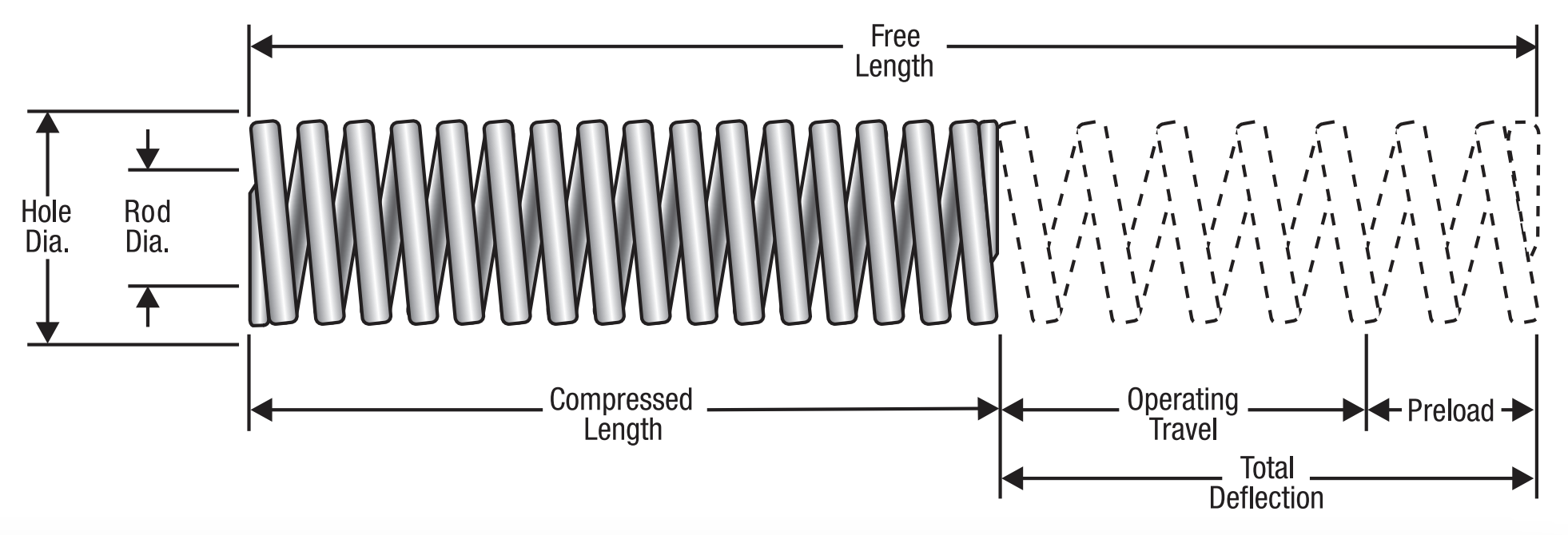
Selecting A Die Spring
You should consider the following critical machine design parameters when selecting a die spring for your industrial application:
- Linear Travel Distance of the Machine (also known as Run Length): The physical travel distance the die or tooling must travel determines the basic size and shape of the die spring. In general terms, first determine the approximate run length of your spring (commonly referred to as short or long run length), which will dictate the compression your spring must accommodate during operation, or its operating travel.
- Cycling Frequency: The cycling speed of the production tooling is the rate at which the spring is compressed and relaxed. At high cycle frequencies, the spring will be vulnerable to fatigue failure, especially if operating near the spring's maximum rated deflection. However, this failure mode is significantly less common in slow-speed fixtures, even when the spring is compressed near the maximum limit. The critical principle is that, for the same spring compression, the expected spring life decreases as the equipment’s working frequency increases.
- Stress Level: Operational stress in the spring is directly proportional to the spring geometry and the application’s load magnitudes. Referring to this as the spring stress is appropriate because, in addition to the operating loads, the stress level is a function of the die spring’s Outer Diameter (shown as the hole diameter in the figure below) and the spring’s Inner Diameter (shown as the rod diameter in the figure below).
Machine Duty Cycle/Rating: The rated duty cycle of die springs is a generic term used to describe the total load and stiffness the spring must possess to accommodate the design loads, displacements, and operational profile. It encompasses the amount the spring deforms under initial equipment loading, called the spring’s preload, plus the spring's operational travel, or the die spring’s total deflection, as shown in the figure below. The duty rating is also determined by the spring's stiffness (or Spring Rate).
NOTE: Never compress a die spring beyond the maximum rated deflection limit (denoted as compressed length in the figure below), which is typically expressed as a percentage of the spring’s free length, or the spring length when unloaded. Exceeding this limit significantly shortens the spring's useful life, especially at high cycling speeds.
Rate Charts
Rate - Pounds Per Inch of Deflection
This chart indicates how the load-carrying capability of the die spring increases by scanning through the color code range of the 3" long spring’s increasing duty capability.
| Hole Size | Rod Size | Free Length | LD (Blue) | MD (Red) | HD (Gold) | XHD (Green) |
|---|---|---|---|---|---|---|
| 3/8" | 3/16" | 3" | 18 | 30 | 42 | 65 |
| 1/2" | 9/32" | 3" | 40 | 57 | 74 | 90 |
| 5/8" | 11/32" | 3" | 56 | 100 | 144 | 180 |
| 3/4" | 3/8" | 3" | 96 | 144 | 312 | 405 |
| 1" | 1/2" | 3" | 152 | 232 | 54 | 736 |
| 1-1/4" | 5/8" | 3" | 240 | 512 | 95 | 1184 |
| 1-1/2" | 3/4" | 3" | 336 | 624 | 122 | 2312 |
| 2" | 1" | 3" | 768 | 960 | 185 | 3120 |
Cycle Life & Maximum Deflection
| LD (Blue) | MD (Red) | HD (Gold) | XHD (Green) | |
|---|---|---|---|---|
| High Cycle Life Range % of Length | 25% to 35% | 20% to 25% | 15% to 20% | 15% |
| Suggested Maximum Deflection % of Length | 50% | 37% | 30% | 25% |
Die Spring Characteristics
Holes and Rod Diameter
Depending on the application, the die spring specification’s Hole Size refers to the diameter of the housing within the machine tooling that the spring fits within. Conversely, the Rod Size refers to the diameter of the guide rod that the die spring is designed to fit over. In either case, both of these dimensions must be correctly specified to ensure sufficient clearance between the die spring's outer or inner surfaces and the surrounding tooling or machine components. This minimizes spring friction on mating components, reducing wear and extending the useful life of the die spring. It also ensures that the spring's load distribution is optimized to prevent buckling or misalignment during compression.
Heat
Thermal effects are frequently ignored in spring failure or loadloss analysis. The maximum rated service temperature for chrome-alloy steel is about 440° F. The following table reflects the approximate load losses due to heat that can be expected with die springs.
Stress Determination
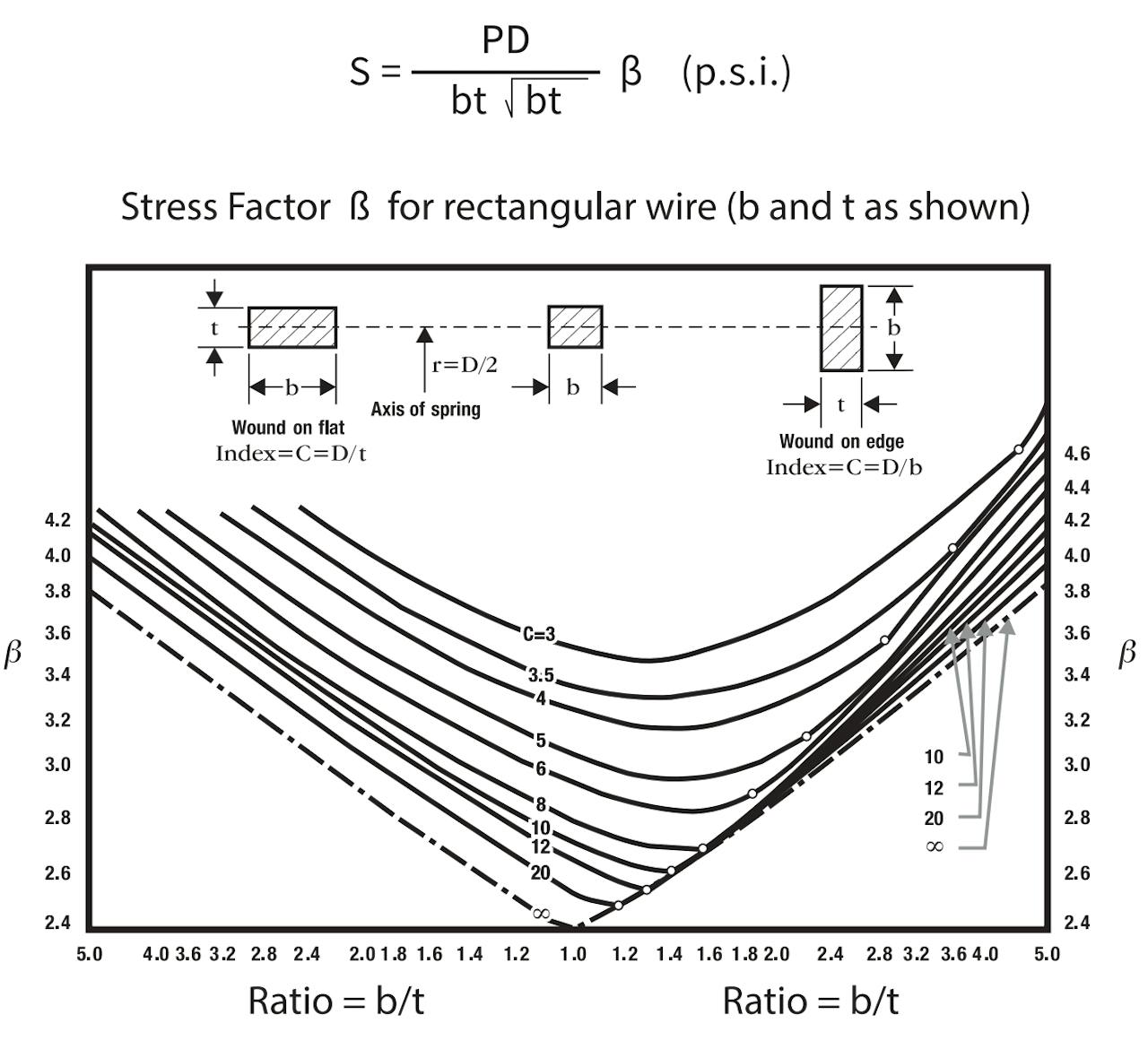
The die wire stress can be estimated with the rectangular wire equation on the right, where:
P = Load, lbs.
D = Mean coil diameter, (O.D. - d) inches
b = Wire width (radially), inches
t = Wire thickness, inches
β = Stress-correction factor, see below
Material and Load Loss Due to Temperature
All of our die springs are fabricated from the most efficient wire cross section, which is rectangular with rounded corners. The oil- tempered die springs are offered for die sets and general use at a reduced cost. A very long service life may be expected from oil- tempered springs if their maximum deflection is held to about 25 percent of their length. The highest grade of electrically-furnaced, shot- peened and preset chromealloy steel die springs are offered for unsurpassed quality
The chart on the right shows the approximate percent of load loss at different temperatures for die springs made from carbon steel and chrome alloy steel.

Die Spring Finishes
Die springs of oil-tempered material are available as unfinished only. A color coding system is employed for our chrome-alloy line for instant visual identification of the spring’s work range and to prevent errors in spring selection and installation. The color coding is a light coating of water-based paint.

Chrome Alloy Finishes
Chrome alloy springs are commonly treated with a distinctive, cosmetic surface finish to permit the quick identification of parts in industrial settings. These colorful finishes allow manufacturing personnel to quickly and reliably identify the proper spring for the given assembly’s duty magnitudes, ensuring reliable operation throughout the equipment's operational cycle. The color table below for chrome alloy die springs can be used to fast-match springs to the correct assembly application.
At the extreme ends, Blue represents Light-Duty mechanisms while Green represents Extra-Heavy Duty mechanisms.
| Color | Range |
|---|---|
| Blue | Light Duty |
| Red | Medium Duty |
| Gold | Heavy Duty |
| Green | Extra-Heavy Duty |
In contrast, oil-tempered steel die springs contain only trace amounts of chrome and silicone and derive their properties primarily from their secondary heat treatment. As a result, such springs do not feature surface-coloring treatments.
Chrome Silicon Finishes
Similarly, chrome-silicon die springs are color-coded according to their load rating. This distinctive surface finish enables reliable identification of springs with the intended load rating required for precision equipment and mechanisms in tool and die assemblies, where proper spring selection prevents catastrophic equipment failures caused by overloading. The color table below for chrome silicone die springs can be used to fast-match springs to the correct load rating and assembly application.
At the extreme ends, Green represents Light-Load applications, while Green represents Extra-Heavy Load applications.
| Color | Range |
|---|---|
| Green | Light Load |
| Blue | Medium Load |
| Red | Heavy Load |
| Yellow | Extra-Heavy Load |
In contrast, oil-tempered steel die springs contain only trace amounts of chrome and silicone and derive their properties primarily from their secondary heat treatment. As a result, such springs do not feature surface-coloring treatments.
Contact Us
For further design and engineering resources, visit the Century Spring resource center or for specific questions related to our products or services, contact us.