Products > Springs

Flat Springs: Types, Applications, and How They Work
In a broad sense, flat springs are mechanical components that store energy under bending loads. They are seamlessly integrated into compact, precision applications and assemblies. Flat springs, both large and small, are cut from metal strips with rectangular cross sections and engineered to provide efficient, repeatable reaction performance in applications with a limited available deflection footprint.
This page provides a broad overview of flat spring subcategories, including available sizes, geometries, and common applications.
What Are Flat Springs?
Flat springs operate by resisting bending forces, in contrast to traditional helical coil springs, such as compression, extension, or torsion springs, which operate by resisting axial compression, extension, or rotational motion, respectively. Put simply, flat springs are subjected to an elastic bending stress that generates a counteractive force opposing the bending.
Certain types of flat springs have nearly thin profiles and large contact surfaces, making them well-suited for mounting, retaining, or contacting components or joints within precision assemblies. All flat springs provide efficient, repeatable force-profile performance in applications with a limited available deformation footprint, accommodating large forces with minimal deflection.
Common Types of Flat Springs
Flat spring is a broad term that refers to a general category of springs that encompasses springs of many different shapes, sizes, and applications. The single unifying characteristic of flat springs is that they are fabricated from flat, thin metallic strip(s) of material with a rectangular cross-sectional profile. The “flat” term reflects the fact that such springs do not possess the familiar helical coil or corkscrew shape(s), which is most commonly associated with springs.
Cantilever and Beam Springs
Cantilever or beam springs are small strips that are constrained at both ends in an arc shape. When a load is applied at the midpoint of the arc, the strip resists deformation, providing a tactile response as it inverts.
Beam springs are commonly found within electro-mechanical assemblies and mechanisms such as switches, buttons, sensors, and controllers.
Belleville (Disc) Springs
Disc Springs are actually slightly conical-shaped and act as low-profile compression springs, providing robust resistance to disc compression along the spring's central axis. They are most commonly integrated into bolted joints as washers that provide preload on the fastener, increasing clamping forces on the joint.
Wave Springs
Wave springs are shaped similarly to disc springs except that they have a low-profile oscillating wave pattern around the perimeter of the disc as viewed from the sides of the spring. This profile is compressed in application and provides a constant reaction force with a very low profile.
Constant Force Springs
Constant Force springs consist of a flat metallic strip of material that has been rolled up into a cylindrical coil. Holes at the ends of the strip provide attachment points for the spring. These springs provide a near-constant resisting force over the entirety of the long spring travel as the coil unwinds.
Leaf Springs
Leaf springs are large, rectangular cross-section strips of metal with slight curvature along their lengths. They are used in automotive suspension and other similar high-load applications and provide resistance to bending and perpendicular forces. Multi-leaf springs are the most common type and consist of numerous stacked, curved metal pieces that provide additional stiffness under high loading.
Where Flat Springs Are Commonly Used
The versatility and compact design have made flat springs a popular choice for mechanisms across a wide range of industries. Because they are formed from flat pieces of metal strips, they can be stamped into many low-profile geometries, engineered to fit into extremely tight spaces where there would not be room for a traditional helical coil spring. As such, they provide a robust retention force and contact surface for el.
Common flat spring applications include electrical contacts and connectors, hold-down clips and retainers, preload washers, and select mechanical linkages. However, it’s important to note that mechanisms that must accommodate large axial displacements or high degrees of angular rotation would likely be better served by a traditional helical coil spring.
Materials Used in Flat Springs
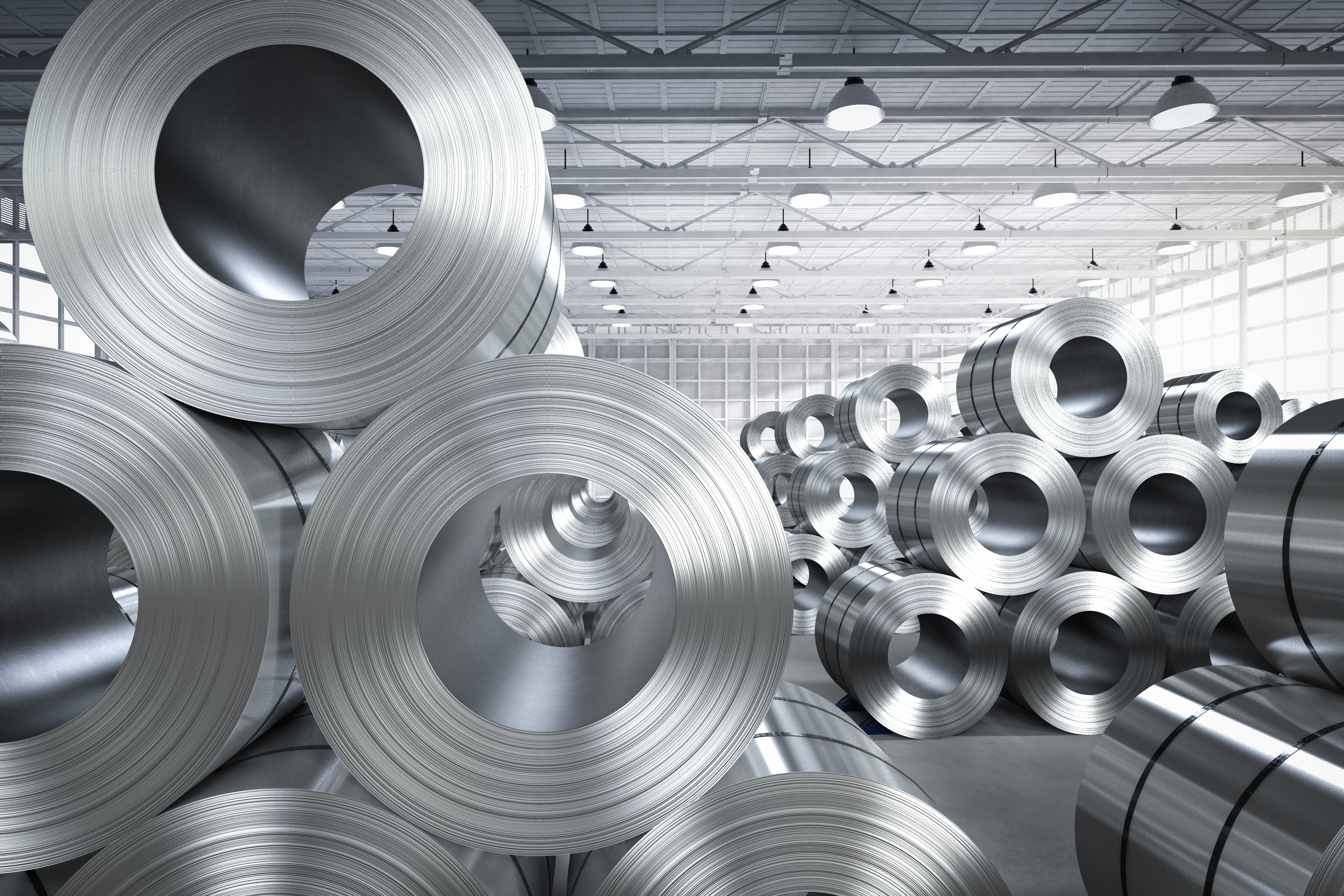
The most common spring materials used to fabricate flat springs are similar to those used to fabricate traditional helical coil springs.
The performance of metallic flat springs depends heavily on both the spring’s base material and surface finish selection, especially in demanding environments. Most flat springs are fabricated from various steel alloys, depending on the application. For example, stainless steel springs offer economic corrosion resistance and performance for corrosive environments and medium-duty industrial applications.
Other common metal spring materials, such as spring steel, provide excellent strength and fatigue resistance. Other metallic alloys, like copper, can be specified for electrical applications. Specialized high-temperature alloys with excellent fatigue life can also be engineered as custom options for aerospace and heavy industrial equipment applications.
Our experienced product engineers can help you navigate all material options for flat springs and specify relevant material standards in your inquiry to ensure compliance, traceability, and reliability.
Advantages and Limitations of Flat Springs
There are numerous advantages to flat springs, but you should balance these against some notable limitations to carefully evaluate when a traditional helical coil spring would better suit your application.
Advantages of Flat Springs
In certain applications, flat springs are the go-to solution for designers because they address problems that traditional helical coil springs cannot.
The most obvious problem flat springs are well-suited to solve is limited space in the mechanism, because flat springs can fit into extremely small crevices, making them well-suited for compact assemblies like bolted joint stackups. They also provide precise, repeatable resistive forces at a small total deflection.
Another less obvious advantage of flat springs is their multifunctionality. A flat spring can also serve as a mounting surface or an electrical contact component, reducing the total number of parts in an assembly.
Limitations of Flat Springs
In many applications, flat springs are not feasible solutions. For example, they can provide only relatively small deflection ranges compared to helical coil springs of similar size and weight. Therefore, for mechanisms that must accommodate large axial displacements or rotations, they are simply not feasible options.
While many stock flat springs are available for immediate shipment, customized flat springs from exotic materials or shapes can be difficult and expensive to manufacture, making them infeasible for such applications.
Additionally, in applications well-suited to flat springs, springs may experience premature fatigue failure under high-cycle loading unless the geometry and materials are specified and engineered accordingly.
Flat Springs vs. Coil Springs
Flat springs are usually preferred for applications with extremely limited space to accommodate spring deformation. In general, they require flat mounting surfaces to provide seamless integration into assemblies or fastened joint stackups.
Conversely, helical coil springs are capable of accommodating large displacements related to linear or rotary machine motion in mechanisms in which flat springs simply were not designed to operate. As such, they can store large magnitudes of energy. For these reasons, you should consider helical coil springs when your mechanism has the design space to accommodate such motion.
Furthermore, the mode in which flat vs. coil springs resist deformation is fundamentally different. For example, flat springs function by elastically resisting bending forces, while coil springs function by resisting either compression, extension, or rotation along the longitudinal coil axis. This affects the spring’s internal stress distribution under deformation, the delivery of reaction forces, and service life.
How Century Spring Can Help
As the most trusted name in spring manufacturing, Century Spring is a quality-first, ISO 9001-certified supplier of stock and custom springs with a proven track record and an established presence in many industries. Our expansive production facilities enable us to maintain a large inventory of high-quality springs and wire form products.
Our value proposition extends well beyond a selection of stock parts. For example, our dedicated customer support teams understand how to navigate critical design criteria, including size, material, and stiffness, to determine the optimal spring for any application, and our talented development engineers collaborate directly with you to optimize custom spring designs engineered to meet unique performance requirements.
FAQs About Flat Springs
What makes a spring a “flat spring”?
Flat springs get their name from the fact that they function by the bending action of thin, “flat” strips of rectangular cross-section metals. Most flat springs are small, stamped or cut metal pieces with integrated features that permit bending under an applied load.
How do flat springs differ from helical coil springs?
At a high level, flat springs function by small bending deflections of rectangular cross-sectional metal strips. In contrast, helical coil springs function by resisting axial extension, compression, or rotation of helical coils formed by the underlying metallic wire.
When is a flat spring preferred over a compression spring?
Flat compression springs, such as disc springs or wave springs, are ideal for applications with limited space where there isn’t room to fit a helical coil compression spring. As such, they provide reliable, precision force control for minimal deflection. They also provide larger, flat contact surfaces for even load distribution and reliable contact for applications that require electrical conductivity.
What limits the lifespan of a flat spring?
Similar to traditional helical coil springs, a flat spring's lifespan is affected by the applied load, spring size, material selection, and operating environment. Additionally, because flat springs are commonly used in bolted joint stackups to apply a clamping preload to the joint, the cyclic frequency of the applied loads can significantly affect the fatigue life of the flat spring, especially for corrosive or high-humidity environments.
What are common sizes for flat springs?
Because the term “flat springs” covers a wide range of spring types, their typical sizes vary as a function of type. However, for typical flat springs (e.g., disc and wave springs) found in electronics, clips, and preload washer configurations, maximum thicknesses are typically up to 0.125”, with outside diameters less than 3” most common. Other large flat springs, like leaf springs found in vehicle suspension systems, can be over 0.5” thick and 2-4 ft. long.
Get In Touch
Contact Information
Contact us directly today to get connected with us for help on all your questions, from general sales to detailed product support information.
If you require immediate assistance, you can speak directly with a live customer service representative on our dedicated line at 800-237-5225.
Request Engineering Support
Our experts are always available to guide you to a spring solution that is perfectly suited to your application's needs. We can dive into your product’s requirements and recommend a range of spring options and alternatives to suit your performance requirements.
Conversely, if you can’t find what you need in our expansive spring and wire form product catalogues, you can also request a custom quotation so we can partner with you throughout all phases of product development to deliver custom springs engineered specifically for your application.