Torsion Spring vs Extension Spring: What’s The Difference?
Torsion and extension springs are two of the most common types of springs used to store and release mechanical energy efficiently. Choosing the right spring for your design depends on the specific type of motion the application requires. For example, torsion springs are specifically engineered to provide precise control of rotational force and torque. In contrast, extension springs are designed to deliver a strong, linear pulling force along a single, straight axis.
While much focus is on comparing how torsion or extension springs are used in different residential garage door mechanisms, these versatile components are integrated into a far broader range of environments and applications. To that end, this guide will look at their integration into broader industrial, commercial, automotive, and product-design applications.
To help you make the best engineering decision, we will preview the critical differences between these two spring types. Specifically, this guide will evaluate each spring type for performance, safety, design space, cost, and use cases.

How Torsion Springs Work
Torsion springs are a type of helical coil spring designed to resist rotational (or twisting) forces. Torsion springs store mechanical energy by twisting into a tighter coil under an applied rotational force at the legs, which are straight segments of wire protruding from the ends of the coiled spring body. During rotation, the spring's body diameter shrinks, and its overall length increases as the coils wind more tightly. Upon unloading, the spring exerts an opposing torque to return the legs to their original position, smoothly releasing the stored energy.
Capable of delivering precise torque over a specific distance, torsion springs are incredibly useful when controlled angular motion is required. You will frequently find them utilized in lever, pivot, and hinge mechanisms across numerous industries, ranging from simple consumer products to complex aerospace control surfaces. To suit the specific spatial constraints and load requirements of such applications, torsion springs are often designed with custom leg configurations, arm angles, body diameters, and winding directions. For instance, it’s critical to specify the correct wind direction of your torsion spring to ensure that the spring properly winds up—rather than unwinding—under the design rotational load.
How Extension Springs Work
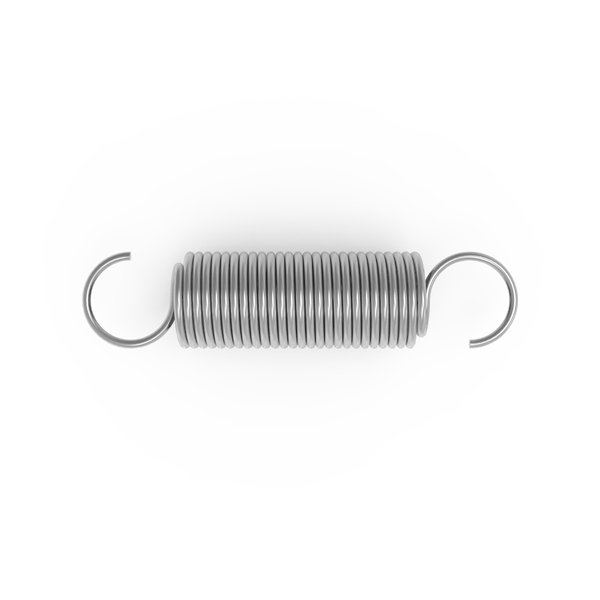
Extension springs are mechanical components that store energy by stretching under an applied tensile load. Extension springs elongate as their tightly wound coils are pulled apart. Because they are designed to resist this pulling force, they generate a strong counteractive pull that returns the spring to its original unloaded length. To securely attach them to the moving parts of a mechanism, extension spring ends are usually hooks, loops, or other customized configurations to reliably connect two components that move apart along a straight axis.
Extension springs are found in applications where components must remain axially connected, return to a specific position, or consistently maintain tension. You can find them seamlessly integrated into everything from residential garage doors and trampolines to heavy-duty automotive assemblies. Ultimately, extension springs are compact and cost-effective components that deliver reliable linear motion control.
Key Differences Between Torsion and Extension Springs
When narrowing down your component options, this main decision-making section will help you evaluate your design. You should note that neither spring type (torsion or extension) is universally better than the other; rather, the correct choice depends on the direction of the force that your mechanism and assembly are designed to accommodate.
Space and Mounting Requirements
Torsion springs are often mounted compactly around a central shaft, rod, or pivot point. Despite this compact mounting profile, they still require sufficient clearance for the spring body and legs to rotate safely through their full angular range. You should also account for the fact that a torsion spring's body diameter will slightly shrink and its overall length will increase as it twists more tightly.
In contrast, extension springs can fit into narrow, straight cavity spaces. They are highly effective in assemblies where the spring can simply stretch along the straight axis and direction of movement. Just ensure that you have sufficient linear space to accommodate the motion of the spring and mechanism(s).
Because of these distinct physical operations, the available mounting geometry within your assembly may sometimes determine the optimal spring type for your design. While much is made of space constraints for garage door spring applications, it is crucial to remember these constraints apply to all product design applications.
Load Control
Torsion springs store and release angular energy, generally offering highly precise and controlled rotational movement. In contrast, extension springs stretch to provide a direct, linear pulling force. Because extension springs are manufactured with an initial tension that must be overcome before the coils even begin to separate. As such, they are particularly useful in applications where an axial tension or "holding" force is required, when the spring is unextended. This initial tension force must be considered in load calculations.
Torsion springs are usually the better choice for applications that require smooth pivoting or heavy counterbalancing, such as levers, hinges, and heavy lids. Meanwhile, extension springs are often better suited for simple return-force mechanisms where two separate components must return along a straight path. In contrast to extension springs, torsion springs do not have an initial tension force to be considered in load calculations.
Matching the correct spring type to your assembly's load-control requirements ensures a smooth, predictable user experience. Furthermore, ensuring that your application directs the force as the spring was designed to handle it prevents excessive stresses and wear, maximizes part longevity, and ensures the long-term mechanical reliability of your mechanism.
Safety Considerations
Regardless of your application, both torsion and extension springs must be carefully specified and properly installed in your mechanism to ensure a safe operating environment.
Because extension springs extend by significant magnitudes during operation, they can rapidly recoil if they experience a sudden mechanical failure. To mitigate this risk, many high-load extension-spring applications require back-up safety cables or containment structures.
Similarly, torsion springs store significant rotational energy, even with small leg-displacement magnitudes, which requires additional design considerations. You should always ensure that you have specified a torsion spring with the correct wire size and coil wind direction, and that it is securely mounted and installed on the spring legs, to permit safe operation without a dangerous release of rotational energy.
Cost and Manufacturing Complexity
When evaluating straightforward tension applications, extension springs are often the simpler and more cost-effective choice to manufacture. In contrast, torsion springs typically require much more precise engineering to ensure they function correctly within a rotational assembly. This increased manufacturing complexity arises because design factors such as leg angles, torque requirements, angular rotation limits, and mounting features add complexity.
While stock springs are always the most economical choice, your mechanism might require specialized geometry, materials, or secondary operations. Ultimately, opting for custom designs will increase your procurement lead time and increase the cost of both torsion and extension springs.
If you aren’t sure where to start in evaluating spring options, you can Request a Custom Quotation today, and our spring design experts will guide you through spring types and configurations suitable for your design application.
Applications for Torsion and Extension Springs
While residential garage doors are the most familiar example of both torsion and extension springs in action, these two types of springs are integral to a much wider range of commercial and industrial equipment.
Century Spring manufactures high-quality torsion and extension springs, relied upon daily by our customers, to deliver reliable performance in safety-critical mechanisms.
Common Torsion Spring Applications
Torsion springs are useful in mechanisms that require a component to rotate back to its original position, hold a specific position, or apply a consistent torque about a central pivot point. Because they excel at delivering precision angular control, these springs are seamlessly integrated into a vast array of commercial, industrial, and consumer applications.
Everyday examples of torsion spring applications include simple hinges, latches, and access panels found in automotive assemblies. In manufacturing settings, they are used as industrial levers and arms to provide reliable rotational torque. They also serve as critical counterbalance mechanisms, allowing massive weights to be lifted or pivoted with minimal user input.
Furthermore, rugged agricultural and construction equipment rely heavily on the durable torque provided by large torsion springs to operate plows and machinery in harsh outdoor environments.
Common Extension Spring Applications
Extension springs are versatile helical coil springs that are especially useful when mechanisms require parts to be securely pulled together, reliably returned to a specific position, or consistently held under tension. Because they provide such a dependable linear pulling force, they are seamlessly integrated into a vast array of both consumer and commercial products. Practical everyday examples of these springs in action include residential screen doors, recreational trampolines, and various types of exercise equipment.
Furthermore, in more demanding and heavy-duty environments, they are used within mechanical linkages, rugged agricultural equipment, complex industrial assemblies, and dedicated tensioning members.
Which Is Better: Torsion or Extension Springs?
In simplest terms, torsion springs are better suited for rotational force, controlled rotation, and counterbalance applications. Similarly, extension springs are better suited for simple linear tension and return force applications.
Because their mechanical function is distinct, what makes one spring "better" than the other depends entirely on the design of your mechanism rather than the spring category itself. The basic principle is described as follows: if you’re asking which is better, torsion or extension springs, start by defining the direction of motion.
Expanding this principle further:
- Choose a torsion spring if the part rotates, pivots, or requires torque
- Choose an extension spring if the part stretches or retracts, or requires tension
Once you have determined the type of spring you need for your application, you may need a custom spring design if your application’s loading, design footprint, cycle life, or end configuration requirements are complex. No matter your application’s requirements, Century Spring is fully equipped to support both your stock and custom spring needs.
How to Choose the Right Spring for Your Application
Ultimately, choosing between torsion and extension springs should involve much more than simply matching a general spring type to your mechanism. To achieve optimal performance, you must think through the full operating environment by carefully evaluating your specific force requirements, movement type, available mounting space, expected cycle life, and exposure conditions.
Match the Spring Type to the Required Motion
The first decision point is to match the spring type to the required motion of your assembly. Torsion springs resist twisting forces, making them best suited for applications that require torque, rotation, pivoting, or controlled angular movement. They function by rotating around the central coil axis, allowing them to provide precision rotational control in components like levers and hinges.
In contrast, extension springs are better suited when a pulling force, continuous tension, or a dependable return movement is required. These springs stretch apart along a single straight axis to absorb energy, creating a counteractive tension that pulls components back together.
By simply identifying whether your components need to rotate or pull apart, you can quickly determine the appropriate spring category for your design.
Consider Load, Deflection, and Stress
Regardless of the type chosen, the spring must be carefully engineered to handle the required force without overstressing the base material. For torsion springs, this involves accurately calculating the necessary torque and the maximum angular deflection the spring legs will experience during rotation. Conversely, when designing with extension springs, you must evaluate the maximum applied load, the overall stretch length, and the initial tension required to begin separating the tightly wound coils. If either spring type is incorrectly sized for its operating environment, it can easily exceed its maximum safe stress limits. Ultimately, this improper sizing can lead to poor mechanical performance, permanent deformation, or premature fatigue failure within your assembly.
Factor in Cycle Life and Operating Frequency
For applications that experience frequent or continuous use, it is crucial to select either a torsion or extension spring optimized for high-cycle lifetime. A spring's operational life is determined by a combination of its base material, operating stress levels, surface condition, and the severity of its operational environment. Surface defects, like cracks or dents, can reduce the spring's ability to withstand repetitive dynamic loading.
While specific cycle life expectations vary wildly depending on the application and assembly, designing the spring to operate well within its maximum safe deflection and stress limits will generally ensure long-term, dependable operation.
Review End Configurations and Mounting Space
Torsion springs require specific leg lengths and orientations that depend on the application. Conversely, extension springs with standard machine-made hooks, full loops, or other custom end types can be used to securely attach the spring ends. Both types of spring end types impact stress concentrations, ease of installation, and durability. For example, extension spring hooks experience additional bending stresses and are often the most vulnerable to wear and premature failure if the spring is improperly sized.
The physical limitations of your available mounting and design space may also determine whether a torsion or extension spring makes more practical sense. If your mechanism lacks the necessary clearance for torsion spring legs to rotate safely through their full angular motion, an extension spring designed for a narrow, linear space envelope might be the superior choice.
Account for Environment and Material Needs
When shopping for either torsion springs or extension springs, your application’s operating temperature and exposure to corrosive and vibrations will impact your material selection. For instance, outdoor, industrial, or high-wear applications frequently require specialized materials, like stainless steel, or protective secondary finishes to ensure long-term durability and safe operation. If your operating environment is particularly demanding, utilizing our custom design support can help you source specialized alloys or engineered coatings perfectly tailored to your project requirements.
Get the Right Spring for Your Design Requirements
Choosing between torsion and extension springs involves evaluating your spatial design constraints, load requirements, expected travel, motion type, and mounting provisions. Torsion springs may be a strong fit when your design requires precise torque, compact rotational movement, or a smoothly controlled return motion around a central axis. Conversely, extension springs are better options when your application needs reliable linear tension and can accommodate axial motion. Selecting the correct spring type for you application will ensures optimal performance and mechanical reliability.
While standard springs usually cover many everyday use cases, custom manufacturing can help when a stock spring simply does not meet your exact force, material, size, or end-configuration requirements. Century Spring supports your torsion and extension spring-driven mechanisms with world-class engineering and manufacturing expertise.
We encourage you to see how Century Spring’s expansive stock spring catalog to find the exact component you need, and shop our springs today.
If you can’t find exactly what you need, your design might need a few modifications, or you may even need a custom spring design. If that is the case, you can Request a Quote and allow our experts to guide you through all phases of the design process to find or design a spring suited to your application.
FAQs About Torsion and Extension Springs
What is the main difference between torsion and extension springs?
The primary difference is that torsion springs twist to create torque, while extension springs stretch to create pulling force. For example, torsion springs are typically used for rotational movement, storing and releasing angular energy by resisting rotational forces applied perpendicularly to their legs. Conversely, extension springs are used for linear, axial tension and displacement, attaching to components that move apart along a single straight axis to provide a controlled resistance or pulling return force.
Are torsion springs stronger than extension springs?
The strength of torsion and extension springs depends entirely on the specific application, load requirements, material, size, and design of your mechanism.
Instead of comparing their outright strength, it is more accurate to evaluate which spring type is structurally designed to best handle the forces within your specific mechanism. For example:
- Torsion springs resist twisting forces and store mechanical energy by twisting into a tighter coil when their legs are rotated. Because they deliver precise torque and motion control over a specific angular distance, they provide far better control in rotational applications, such as levers, pivots, and hinges.
- Extension springs resist tension forces along a single straight axis, extending in length as they are pulled apart. Because of this design, extension springs can provide a linear pulling or return force in compact assemblies where components move apart.
For both spring types, the actual load-carrying capacity is dictated by physical geometry—such as the wire diameter and outer diameter—and the spring’s material properties. For instance, specifying a thicker wire diameter or choosing a high-strength alloy will significantly increase the strength of either a torsion or an extension spring.
Can torsion and extension springs be custom-made?
Yes, both torsion and extension springs can be custom-made for specific load, size, material, and end-configuration requirements. Custom spring configurations are needed when standard stock springs cannot meet all of your design requirements, such as the design envelope, lifecycle, or load and mounting requirements of your mechanism.