Custom & Stock Metal Springs for Every Application
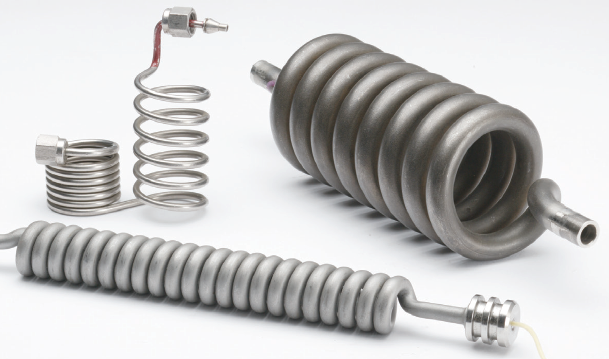
Metal springs are most commonly helical coil wire springs, defined by their distinctive helical wire configuration. Other common stock and custom metal springs include disc springs and flat springs.
The most common types are metal compression, metal extension, and metal torsion springs. As the names suggest, these springs are differentiated by the direction of the loads they are designed to accommodate. The specific design application determines the magnitude and direction of the forces and displacements the metal spring must absorb.
As such, metal springs of all types, sizes, and materials are integrated into machine components across various industries, including aerospace, medical, automotive, and consumer products.
Century Spring is your trusted supplier for rapid fulfillment of high-quality stock and custom metal springs engineered to precise performance specifications. All our metal springs and wire form products are engineered for quality, performance, and reliability. They are formed from premium materials using cutting-edge technologies to deliver products engineered for precision and reliability in the most demanding applications.
Explore Our Metal Springs Range
Century Spring is proud to offer a vast selection of stock metal springs, including standard helical coil wire springs, disc springs, and flat springs, in a wide range of materials and sizes. You can browse our extensive product catalogue by outer diameter, wire size, spring rate, material, surface finish, and more. Additionally, you can download the spring CAD file to verify the fit within your application before making a purchase.
Place your order now to take advantage of same-day shipping.

Custom Metal Springs
If you can’t find the metal spring you need in our extensive catalog, we offer custom metal spring design and manufacturing services, partnering with you at all stages of development—from initial concept to procurement—to develop metal springs engineered for your exact performance requirements in any application. Typical metal spring customization options include material, spring rate, end configurations, and surface treatments to protect against corrosive operating environments.
Our team of spring design experts consistently works to expedite the development of metal springs, delivering springs that meet specific size and tolerance specifications, as well as operating conditions that include target lifecycle and environmental requirements.
Don’t waste another minute if you need a novel, high-performance metal spring solution - Request a Custom Quotation today!
Metal Spring Manufacturing Capabilities
Century Spring combines state-of-the-art manufacturing tools with in-house design expertise to deliver custom solutions engineered to function reliably in assemblies and applications where performance and dimensional accuracy are driving requirements. Our cutting-edge computational equipment includes CNC spring coiling machinery, which enables us to manufacture metal springs with precise geometric tolerances and load control.
We employ industry-leading Quality Controls, including raw material certification backed by full ISO 9001 and AS9100D certification, along with cutting-edge manufacturing capabilities that incorporate computational simulation and testing techniques. Our equipment is fully equipped with digital load-testing equipment to verify that your spring meets your precise loading and lifecycle requirements. We also offer springs that qualify for complete Production Part Approval Process (PPAP) submission level classifications, which provide independent verification of our ability to consistently manufacture parts that comply with all customer design and quality specifications.
Typical metal spring Customization Options include Wire Diameter, Outer Diameter, Coil Pitch, and End Type, depending on the type of metal spring. For example, metal compression spring options include Open and Closed/Ground ends. Extension spring end types include various Hook and Loop configurations. Common torsion spring customization options include Leg Orientation and Coil Wind.
Typical custom metal spring material options include stainless steels such as 302, 304, 316, and 17-7, as well as high-strength material options with excellent fatigue resistance, including phosphor bronze and beryllium copper.
We also offer exotic, ultra-high-performance material options, including Inconel®, Hastelloy®, Elgiloy®, and A286, for applications that demand reliable performance in highly corrosive, high-temperature, and high-load environments.
Finally, we have a vast selection of Secondary Process capabilities and options, including custom heat treatments, shot peening, and surface coatings.
Our Custom Manufacturing Services include extensive design for manufacturability (DFM) expertise and comprehensive prototyping capabilities, allowing for the quick refinement of design solutions. Our dedicated, high-speed machines can quickly scale concept production to large part volumes.
What Our Customers Are Saying
“Terrific customer service agents who are willing to research and find the answer if they don't know. Nice email updates and quick product delivery.”
“I am surprised that a big company like yours would work with us little guys. And Thank You because we don't have another source for springs.”
“The website works really well, that is very important to me to find what I need quickly and accurately.”
Metal Spring Information & Resources
Metal Spring Types & Typical Uses
Metal springs are extremely versatile, making them well-suited for use in nearly unlimited machine configurations across various industries and product categories. Here are a few of the highlights grouped by spring type.
Metal Compression Springs
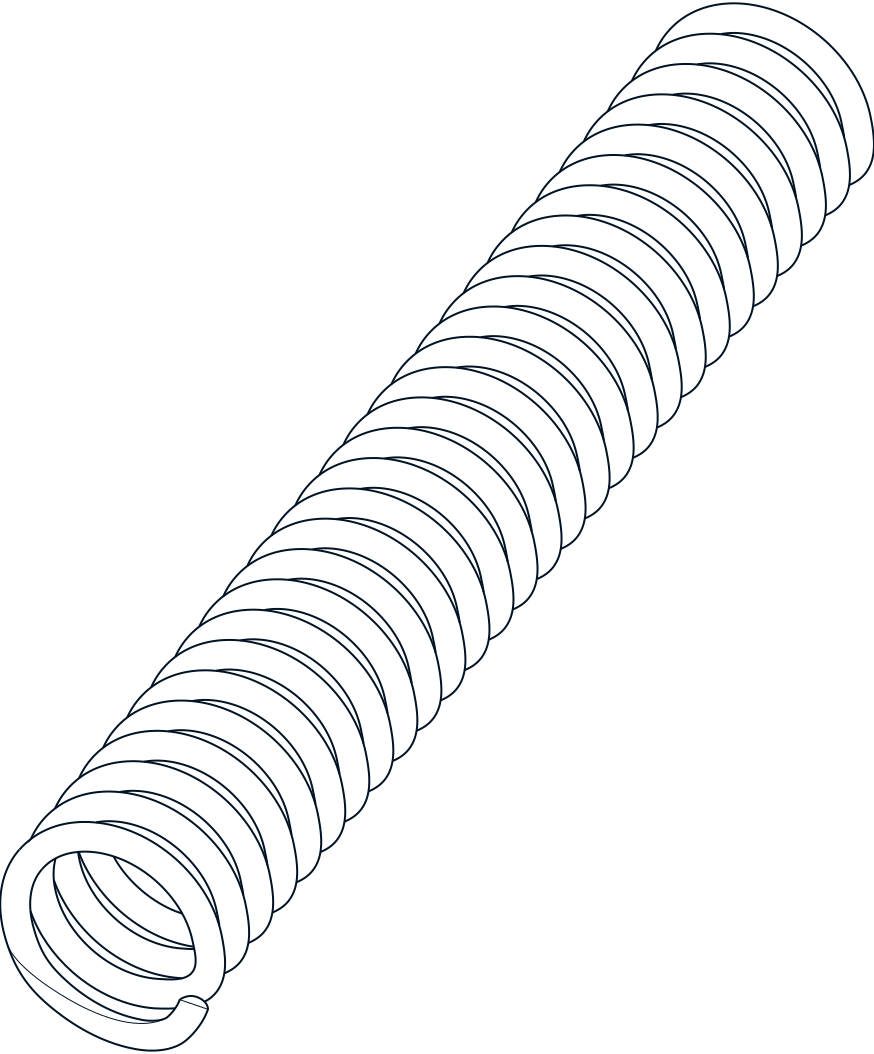
Metal compression springs are designed to resist compressive forces, meaning the coils are compressed together under an applied compressive load, storing compressive energy. They are used in mechanisms that require the absorption of compressive motion, shock loads, and vibrations.
Metal compression springs of various sizes are integrated into an innumerable components and assemblies across many industries. For example, they are found in critical aerospace safety systems, most notably in aircraft shock-absorbing and suspension systems, as well as in consumer products such as mattresses and box springs.
Metal Extension Springs
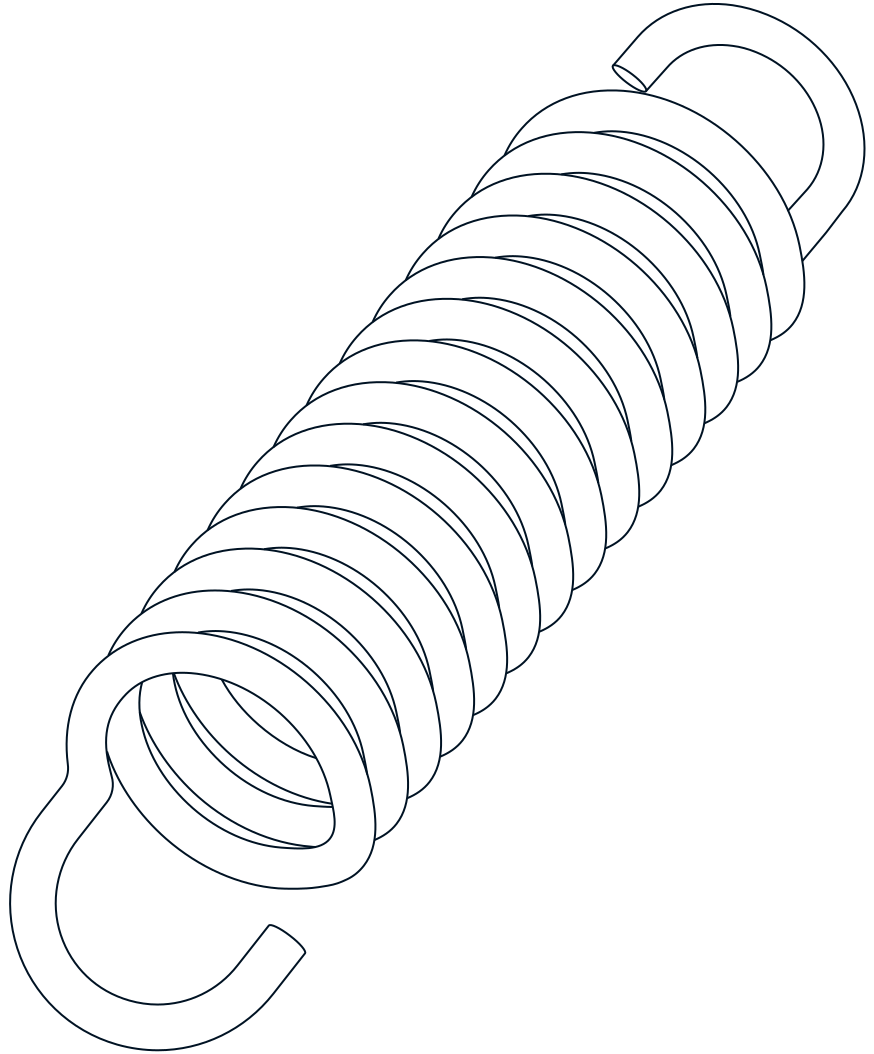
Metal extension springs are designed to resist tension forces. They are similar to helical compression springs, except that their coils are wound tightly together and are separated under an applied tension load. An extension spring’s initial tension refers to the tension force needed to separate the helical coils just enough for light to pass through them. As the coils separate, they store energy and create a resisting force that acts opposite the direction of the spring extension.
Metal extension springs are integrated into industrial automation applications within actuated systems, where a tension force is needed to open or close bay doors.
Metal Torsion Springs
Metal torsion springs are designed to resist twisting forces. They are tightly wound wire coils that unwind elastically under an applied torsion. The torsion spring stores energy by opposing motion at the legs that would twist the spring coil into a tighter wind. Body Width, Leg Length, and Angle between Legs define metal torsion springs.
Some common consumer product examples of torsion spring applications include simple torsion springs in wooden clothespins and torsion spring brackets designed to hold recessed ceiling lighting in mounting fixtures.
For more information on industry-specific spring applications, navigate to our dedicated Industry pages:
How to Select a Metal Spring
Generally, critical metal spring properties common to all types of metal springs include Wire Diameter, Outer diameter (OD), and Spring Rate.
Important metal compression spring design characteristics include Spring Pitch, Total Number of Coils, and Solid Spring Length. Important metal extension spring design characteristics are the spring's Maximum Deflection and Maximum Load Capacity. Finally, notable torsion spring properties that must be considered include the spring’s Angle between Legs, Inner Diameter (ID), and Leg Length.
After evaluating the working load your metal spring must withstand, you can shop by Spring Rate, considering the key geometric properties above to determine how the spring will fit within your application. The spring rate will allow you to calculate the spring displacement in your application. Using this value, you can determine in more detail how the spring will fit within your machine design during loading. In totality, these properties will help you determine the fit and function of your metal spring in your application.
Our spring design experts have developed three standalone spring selection guides packed with valuable information and resources on spring selection and sizing.
How to Select a Torsion Spring
Materials & Finishes for Metal Springs
The performance of metal springs in application depends heavily on both the spring’s base material and surface finish selection, especially in demanding environments.
Stainless steel springs offer economic corrosion resistance and performance for medical device applications and medium-duty industrial applications.
Other common metal spring materials, such as Music Wire, provide excellent strength and fatigue resistance, but are generally not suitable for corrosive environments unless an additional protective surface finish or coating is specified.
High-temperature alloys, such as Inconel®, are high-performance material options that are excellent choices for high-temperature applications, including aerospace turbines, and maintain their high strength even under extreme temperatures.
Common surface treatments for metal springs include passivation and plating treatments, which are typically used to increase the spring’s corrosion resistance. Shot peening is a surface treatment used to enhance the fatigue life of a spring. Epoxy or polymer paints and coatings can also be specified to provide an additional layer of protection against surface scratches and dents.
When shopping for metal spring materials and surface coatings, always specify relevant standards in your RFQ (such as ASTM, MIL-SPEC, or NAS) to ensure compliance, traceability, and performance reliability in mission-critical systems.
FAQs About Metal Springs
What types of metal springs does Century Spring offer?
Century Spring offers a wide range of metal springs, including helical coil compression, extension, and torsion springs. Additional popular metal spring offerings include die springs, disc (or Belleville) springs, tapered, and drawbar springs. Common metallic spring materials include music wire, stainless steel, spring steel, and nickel-based superalloys.
How do I choose the right metal spring for my application?
The direction and magnitude of the forces and displacements your metal spring must accommodate are the first determinations that will dictate whether you need a metal compression, extension, or torsion spring.
After evaluating the working load your metal spring must withstand, you can shop for metal springs by spring rate to determine the amount of spring deformation required to provide the force your application needs.
While browsing by spring rate, pay attention to the spring’s other geometric properties, such as Outer Diameter and the Number of total Coils, which allow you to evaluate how the spring will fit within your machine design during loading. In totality, these properties will help you determine the fit and function of your helical spring in your application.
Once you have an idea of the geometric properties your metal spring requires, you can evaluate the operating conditions it will encounter. This will help you begin considering material and surface finish options.
What are the most common uses for metal springs in different industries?
Metal springs are integrated into many mechanisms across various industries due to their versatility and efficient mechanical functionality. The most common industries include automotive, aerospace, industrial equipment, medical devices, and electronics.
Can you manufacture custom metal springs to tight tolerances?
Yes, while our stock metal springs are fabricated to modern manufacturing standards and tolerances with tight tolerances on linear and angular dimensions, if you believe you need a custom metal spring with a specific tolerance on a key dimension or property, you can contact us anytime at 800-237-5225 or complete our Custom Quotation Form today.
In general, spring tolerances depend on the type and geometry of the spring. Century Spring has developed tolerance equations for various manufacturing techniques and combined this analysis with the best industry standards to create general tolerance ranges for metal spring geometry.
If you Contact Us today, we can provide you with general dimensional tolerance values for your exact spring type and geometry.
How do I measure a metal spring to ensure proper replacement?
To replace a metal spring correctly, you’ll need to take precise measurements of several physical dimensions and understand the nomenclature associated with metal spring dimensions, so you can specify a suitable replacement.
Using calipers or a similar measuring device, measure the thickness of the wire that forms the spring coils to determine the spring’s Wire Diameter. Next, measure the outer surfaces of the helical coil to determine the spring’s Outer Diameter. If possible, measure the undeformed length of the spring to obtain the spring’s Free Length. Finally, count all the coils on the spring to determine the spring’s Total Number of Coils. Perform multiple measurements and counts to ensure accuracy in all dimensions.
If you obtain these key dimensions for your spring application, you will be well-equipped to browse our extensive catalog of stock springs and find a suitable replacement spring.
Why Choose Century Spring
Our Commitment to Quality and Service

As the most trusted name in spring manufacturing, Century Spring is a quality-first, ISO 9001-certified supplier of springs and wire-formed products, specializing in both stock and custom springs. With an established industry presence and a proven track record, our large-scale production facility enables us to maintain a large inventory of high-quality springs and wire form products.
We offer rapid delivery on over 40,000+ stock springs, available to ship today. Our products are always made in the USA.
Innovation and Customization in Spring Manufacturing
Century Spring combines state-of-the-art manufacturing tools with in-house design expertise to create custom spring solutions engineered to withstand any environment and meet the most stringent quality control standards. We also offer prototyping services for custom designs coupled with the capability to quickly scale to production quantities, minimizing total project development time.
Our cutting-edge computational equipment, simulation and testing techniques, including CNC compression self-monitoring and coiling machinery, enable us to deliver durable and reliable wire form products in a wide range of custom sizes and styles. We also have dedicated, high-speed machines that can quickly scale high-quality production to large part volumes.
Our team works alongside you to create, refine, and optimize spring designs to fit specific tolerance and performance design requirements.
Get In Touch
Contact Information
Contact us directly today to get answers to all your questions and allow our experts to guide you through our expansive selection of metal springs.
If you require immediate assistance, you can speak directly with our team on our dedicated customer service line at 800-237-5225.
Request a Quote and Consultation
You can always Request a Custom Quotation to begin a partnership in the joint design and development of custom solutions tailored to your specific product and performance requirements.